Part 5 of 7 · AI and the craft
AI engineer, applied AI engineer, ML engineer, prompt engineer, research engineer: who actually does what?
AI job titles overlap, drift and mean different things at different companies. A plain map of the roles: what each one builds, the skills it needs, how it's interviewed, and which one a team actually needs when it says 'we need an AI person'.
The verdict, which we’ll earn below: sort the roles by where they work relative to the model:
- Research scientists invent new methods for training and understanding models.
- Research engineers build the code and infrastructure that turn those ideas into trained models at scale.
- ML engineers train, evaluate, deploy and run models, often your own, on your own data.
- AI engineers (often called applied AI engineers) build products on top of models someone else trained: prompts, retrieval, tools, agents, evaluations, and the software around them.
- “Prompt engineer” was a 2023 title that has mostly folded into the AI engineer’s job.
Titles vary a lot between companies, so read the job description, not the title.
The case starts with a job board. Five titles that sound nearly identical, and five very different jobs hiding behind them. The usual suspect is the title itself, and it’s a poor witness: it tells you almost nothing. I find it exciting that the field has grown enough to need a map at all. A few years ago most of these jobs were one blurry role; now each has its own craft, and each one depends on the others to make anything work.
This post describes common usage across the industry, as of late 2026. Where a company uses a title differently, the job description wins.
Case file
The case Five near-identical AI titles, five very different jobs Suspects The job title itself Culprit Where the role works relative to the model The fix Read the job description, and ask who trains the model
The suspects, on one map #
| Role | Works on | Builds | Core skills | Typical background |
|---|---|---|---|---|
| Research scientist | New methods for training and understanding models | Papers, experiments, new architectures or training techniques | Maths, ML theory, experiment design, writing | PhD or equivalent research record |
| Research engineer | Making research run, at scale | Training and evaluation infrastructure, distributed training, experiment tooling, efficient kernels | Strong software engineering, ML fundamentals, distributed systems, GPU performance | Software engineer who went deep into ML, or research-minded engineer |
| ML engineer | Models trained on the company’s data | Data and feature pipelines, training jobs, model serving, monitoring for drift | ML fundamentals, data engineering, production engineering | Software or data engineer who learned ML |
| MLOps / ML platform engineer | The platform other ML people use | Training and serving platforms, feature stores, model registries, GPU scheduling | Infrastructure, Kubernetes, CI/CD, cost control | Platform or SRE engineer |
| AI engineer / applied AI engineer | Products built on foundation models (often via an API) | LLM features: prompts, retrieval (RAG), tool use and agents, evaluation, guardrails, cost and latency tuning | Software engineering first; LLM behaviour, evaluation, product sense | Backend or full-stack engineer |
| Forward-deployed engineer / solutions engineer | A customer’s problem, with the company’s AI product | Integrations, prototypes, deployments with the customer | Engineering plus customer and domain skills | Engineer who likes customers |
| Data scientist | Questions about the business, answered from data | Analyses, experiments (A/B tests), statistical models, dashboards | Statistics, SQL, communication | Statistics, economics, analytics |
| Prompt engineer (fading as a separate title) | The instructions and examples sent to a model | Prompt libraries, evaluation sets, documentation | Clear writing, domain knowledge, systematic testing | Varied: writers, domain experts, engineers |
| AI safety / alignment researcher | Whether models behave as intended, and how to tell | Evaluations for dangerous capabilities, interpretability research, training methods | Research skills, ML, careful reasoning | Research |
The look-alikes people confuse most #
The table looks orderly; real life is less so. Here’s where the lines get fuzzy, and the single question that tells each pair apart.
AI engineer vs ML engineer #
One question settles most of it: who trains the model?
- An ML engineer usually trains or fine-tunes models on your own data (a fraud model, a recommender, a classifier) and owns that model’s lifecycle: features, training, evaluation, serving, drift.
- An AI engineer usually starts from a foundation model someone else trained, reached through an API or self-hosted. Their craft is making it reliable inside a product: retrieving the right context, structuring outputs, calling tools, measuring quality, handling failures, and keeping cost and latency in budget.
In practice the two meet in the middle: AI engineers fine-tune small models, and ML engineers build LLM features. But the starting point, and therefore the skill emphasis, differs. It’s a pleasingly simple test for a confusing pair.
Applied AI engineer vs AI engineer #
A bit of a red herring: mostly the same job. “Applied” signals “building with models for a real use case”, as opposed to research. At some AI labs, “applied AI” teams work closely with customers to get models deployed, much like forward-deployed engineers. At other companies, an applied scientist is a scientist role with an emphasis on shipping. Read the description.
Research engineer vs research scientist #
Both work on frontier research, and the line is about emphasis:
- Scientists decide what to try and why, design the experiments, and interpret the results.
- Research engineers make the experiments possible and fast: training infrastructure across thousands of accelerators, data pipelines, evaluation harnesses, and performance work.
At many labs the boundary is blurry and people move between them. Excellent engineering is one of the scarcest skills in research, and I think it deserves more credit than it gets: many of the ideas that work only work because someone made them run.
Prompt engineer: the title that vanished #
In 2023, writing prompts that got reliable results was new enough to be a job title. Then the trail goes cold. Since then:
- models have become better at following plain instructions;
- tooling has matured (structured outputs, tool calling, evaluation frameworks);
- the work turned out to be inseparable from engineering: you can’t improve a prompt without an evaluation set, a way to measure regressions, and code around it.
So the skill didn’t disappear; it was absorbed. It’s alive and essential, but the separate title mostly isn’t. It’s now part of what an AI engineer does, and part of what domain experts contribute to evaluation sets.
The alibis: what each role actually does all day #
Titles tell you little; the shape of a normal Tuesday tells you a lot.
- AI engineer:
- writes code (most of the time);
- builds and runs evaluations;
- reads model outputs, a lot of them;
- adjusts retrieval, prompts and tool definitions;
- investigates why a case failed;
- watches cost per request and latency;
- talks to product people about what “good” means.
- ML engineer: data pipelines, feature work, training runs, offline evaluation, serving infrastructure, and monitoring a model whose accuracy slowly drifts as the world changes.
- Research engineer: debugging distributed training, making a training run 20% faster, building evaluation infrastructure, reproducing a paper, and supporting scientists’ experiments at scale.
- Research scientist: reading papers, forming hypotheses, designing and analysing experiments, and writing up what was learned.
- Data scientist: SQL, analysis, experiment design, explaining results to decision-makers. Increasingly also using LLMs as tools in analysis.
How they’re questioned (roughly) #
| Role | Expect |
|---|---|
| AI engineer | Coding; system design for an LLM feature (retrieval, evaluation, failure handling, cost); discussing a project you built and how you measured it |
| ML engineer | Coding; ML fundamentals (bias/variance, metrics, leakage); ML system design (training and serving pipelines) |
| Research engineer | Strong coding; ML fundamentals; performance and distributed systems; sometimes implementing a model component from scratch |
| Research scientist | Research discussion of your work; ML depth; sometimes maths; a research talk |
| Data scientist | SQL; statistics and experiment design; case studies; communication |
Now let’s put the map to work on three real cases, each with a different choice to make.
Case 1: a backend engineer moving into AI work #
The shortest path is AI engineering, because your existing strengths are most of the job: APIs, data modelling, reliability, testing, observability. What to add:
- How models behave: context windows, sampling, structured output, tool calling, and where they fail.
- Retrieval: embeddings, chunking, hybrid search, re-ranking.
- Evaluation: building a labelled test set, measuring, catching regressions. This is the skill that separates demos from products.
- Cost and latency: tokens, caching, smaller models for easy cases.
Build one real thing end to end, with an evaluation that shows how well it works. My LLM document-ingestion pipeline is an example of that shape: rules first, a model where rules fail, and a measured accuracy number for every change (the post about it).
Case 2: a team that says “we need an AI person” #
Ask what you want them to ship. The answer names the culprit you actually need:
- “Add LLM features to our product”: an AI engineer. Usually a strong software engineer with LLM experience, not a researcher.
- “Predict churn or fraud from our own data”: an ML engineer (and possibly a data scientist).
- “Build our own foundation model”: a research team, and the budget that comes with it. Very few companies need this.
- “Help customers adopt our AI product”: a forward-deployed or solutions engineer.
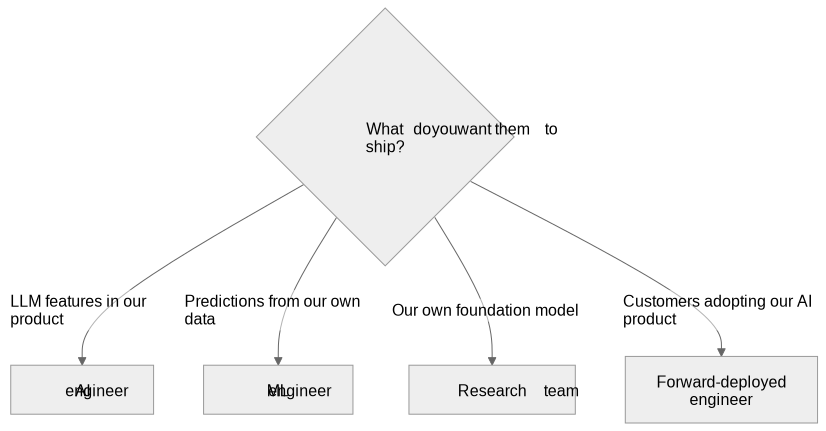
Diagram source
flowchart TD
  A{"What do you want them to ship?"} -->|LLM features in our product| B["AI engineer"]
  A -->|Predictions from our own data| C["ML engineer"]
  A -->|Our own foundation model| D["Research team"]
  A -->|Customers adopting our AI product| E["Forward-deployed engineer"]
The most common hiring mistake is a case of mistaken identity: hiring a researcher to build a product feature, or a prompt specialist without engineering skills to own a production system.
Case 3: a new graduate choosing a path #
- Research (scientist or engineer) usually means a research track record: publications, a PhD, or exceptional open-source or engineering work in ML. It’s competitive, and concentrated in a small number of labs.
- AI and ML engineering is open to strong software engineers, and the demand is broad: almost every product team is adding AI features.
- Either way, software engineering fundamentals compound. Data structures, systems, testing and debugging are what every role above relies on, including research. The next cases to read are what to learn first and how to stay valuable mid-career.
Remember this
- Sort AI roles by where they work relative to the model.
- Who trains the model? That one question separates ML engineer from AI engineer.
- The title tells you little: the job description wins.
What to do on Monday, reading job titles #
- Read the responsibilities, not the title. “AI engineer” at one company is “ML engineer” at another.
- Ask where the model comes from: trained in-house, fine-tuned, or used via an API. That decides most of the job.
- Ask how quality is measured. A team that can’t answer is hiring for a demo, not a product.
- Pick the role whose day-to-day you’d enjoy. Reading model outputs and writing evaluations, running training jobs, and designing experiments are very different days.
The satisfying end to this case is that there’s no villain. Every one of these roles is interesting, and they need each other. Whichever you choose, you’ll be working alongside people solving the other half of the same puzzle.
Role descriptions reflect common industry usage in late 2026; titles and boundaries vary by company and change quickly. No company’s internal ladder is described here.
Comments
No comments yet.
Sign in to comment. We'll email you a link; no password needed.