Part 2 of 7 · AI and the craft
Starting out in software in the age of AI: what should you learn first?
Learn the fundamentals deeply enough to check an AI's work, build real things end to end, and learn to explain and verify what you built. Advice for new graduates, career switchers and interns joining teams where AI writes much of the first draft.
Short answer: the verdict, which the rest of this post sets out to earn: learn the fundamentals deeply enough to check an AI’s work, not only to produce code:
- how programs run;
- data structures and complexity;
- how databases and networks behave;
- testing and debugging.
Then build real things end to end: deployed, used, measured. Learn to explain and verify what you built. Use AI assistants every day, but as a tutor and a pair, not as a substitute for understanding. Early on, the goal isn’t to ship the most code. It’s to become someone whose judgement can be trusted.
Here’s the case as many newcomers feel it: if a tool can write the code, what’s left for me to learn? The usual suspects get named quickly. Learn the hottest framework. Learn to prompt. Learn nothing, because it’s all automated. Each of those is a false lead, and the real answer turns out to be both older and more hopeful. I think this is an exciting time to start. You have a patient tutor available at any hour, and the fundamentals underneath are as rewarding as they ever were: there’s still nothing quite like the moment a hash map, a transaction or a TLS handshake finally makes sense.
Case file
The case If a tool can write the code, what’s left for me to learn? Suspects The hottest framework, prompting, nothing at all Culprit Mistaking producing code for being able to check it The fix Fundamentals deep enough to verify AI’s work, real projects end to end, explaining what you built
The trail, stage by stage #
| Stage | Learn | Why it still matters with AI | A project that proves it |
|---|---|---|---|
| 1. How programs work | One language well (its types, errors, memory and concurrency model); the command line; Git | You can’t judge code you can’t read and run in your head | A command-line tool others actually use |
| 2. Data and complexity | Arrays, hash maps, trees, heaps, graphs; big-O; when each is used | AI picks a data structure; you need to know when it picked the wrong one | Implement and benchmark two approaches to the same problem |
| 3. Databases | SQL, indexes, transactions, isolation, migrations | Most production bugs and slowdowns live here | An app with a real schema, migrations and a slow query you fixed |
| 4. The web and networks | HTTP, DNS, TLS, caching, APIs, authentication | Every system you’ll touch is a networked one | Deploy an API with a domain, HTTPS and auth |
| 5. Testing and debugging | Unit and integration tests; reading logs and traces; reproducing bugs | Verification is the skill AI makes most valuable | A bug report you diagnosed end to end, written up |
| 6. Running software | Deploying, monitoring, logs, backups | “Works on my machine” isn’t done | Something running that you’d notice if it broke |
| 7. Building with AI | Prompting, structured output, retrieval, evaluation | It’s a normal part of the toolbox now | An LLM feature with an evaluation set and a measured accuracy (see the LLM evals post) |
Notice the pattern in the third column. Every row says the same thing in a different way: the tool can produce an answer, and you need to be the one who can tell whether it’s right. That’s the thread that runs through the whole case.
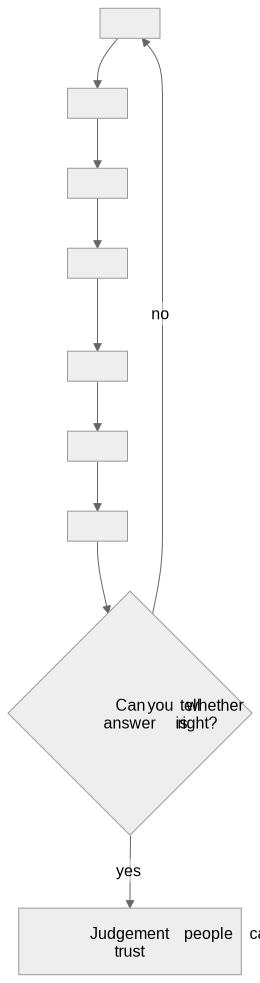
Diagram source
flowchart TD
  A["1. How programs work"] --> B["2. Data and complexity"]
  B --> C["3. Databases"]
  C --> D["4. The web and networks"]
  D --> E["5. Testing and debugging"]
  E --> F["6. Running software"]
  F --> G["7. Building with AI"]
  G --> H{"Can you tell whether the answer is right?"}
  H -- no --> A
  H -- yes --> I["Judgement people can trust"]
Case 1: a new graduate #
You have the theory, which is a real head start; what’s missing is evidence that you can deliver.
- Build two or three real projects end to end, not ten tutorials. Deployed, with a README that explains the problem, the design, the trade-offs and how you tested it.
- Read real code: well-maintained open-source projects in your language. Notice how they structure things, test them and handle errors.
- Contribute somewhere small: a documentation fix, a bug fix, a test. Getting a change merged by strangers teaches review, communication and standards.
- Use AI to learn faster: ask it to explain code, to quiz you, to critique your design, to suggest test cases you missed. Then check what it says.
Case 2: a career switcher #
You bring something many new graduates don’t: domain knowledge, and experience working with people.
- Build software for the domain you know. A tool for your old profession shows you can understand users and turn their problems into software, which is rarer than raw coding skill.
- Go deep on fundamentals deliberately. Self-taught paths often skip data structures, databases and networking. They’re what interviews test, and what lets you debug real systems.
- Show your judgement: write up why you chose one approach over another, and what you’d do differently.
Case 3: an intern on a team that uses AI assistants #
- Understand every line you submit. If an assistant wrote it, you’re still the author. Be ready to explain any of it in review (the post on what developers do when AI writes code goes further).
- Ask why as well as how: why the team designed things the way it did is knowledge you can’t get from a model.
- Learn the team’s tools for verification: how they test, how they deploy, how they know production is healthy.
- Write things down: a short summary of each task (what you changed, why, how you tested it) builds the habits senior engineers rely on.
The habits that crack most cases #
These are small, and that’s their charm: each one is easy on its own, and together they turn you into the engineer people want to work with.
- Read error messages and docs first, then ask. The habit of finding answers yourself is what makes you good at the hard ones.
- Measure instead of guessing: time it, profile it, count the queries. A measurement is the closest thing software has to a confession.
- Write clearly: pull-request descriptions, design notes, bug reports. Clear writing is how engineers scale, and it’s also how you get good results from AI.
- Take ownership of small things completely: finish them, test them, deploy them, watch them.
- Keep a learning log: what you learned, what surprised you, what you’d do differently.
Red herrings: what not to worry about #
- Knowing every framework. They change; fundamentals don’t.
- Competing with AI on typing speed. That race is over. Compete on understanding, judgement and reliability.
- Picking the perfect first job. Choose a place where you’ll get real responsibility and honest code review.
Remember this
- Learn fundamentals deeply enough to check an AI’s work.
- Build a few real things end to end: deployed, used, measured.
- Understand every line you submit, whoever wrote it.
The reveal #
Most of what I rely on after more than ten years in software (debugging a slow query, reasoning about a race condition, designing a data model, reviewing a risky change) comes from fundamentals I learned early and practised on real systems. AI makes those fundamentals more valuable, because they’re what let you use it well. That’s the satisfying twist in this case: the thing people feared would make the basics obsolete is exactly what makes them worth more.
So learn the foundations with curiosity rather than dread. They’re not a toll you pay before the real work starts; they’re the part that stays interesting for a whole career.
Comments
No comments yet.
Sign in to comment. We'll email you a link; no password needed.