Part 3 of 7 · AI and the craft
5-15 years in: how do you stay valuable as AI changes the work?
When AI can write much of the code, an experienced engineer's value is in the decisions: what to build, how systems should behave under failure and load, how teams deliver, and what's safe to ship. Three paths (go deeper, go broader, go into AI) and how to choose between them.
The verdict, which the rest of this case earns: move your value from producing code to making decisions that are hard to undo, and making them well:
- system design under real constraints;
- reliability, cost and security trade-offs;
- turning vague problems into clear plans;
- raising the quality bar for a team;
- being the person trusted with production.
Then choose a direction deliberately:
- deeper (staff or principal engineer: the hardest technical problems, across teams);
- broader (engineering manager or lead: people, delivery and organisation);
- into AI (building AI products, where engineering experience is badly needed).
Use AI tools heavily in whichever you choose. Experienced engineers get the most out of them, because they can tell when the output is wrong.
Case file
The case Code is getting cheaper to produce, so what was I paid for? Suspects Typing speed, framework corners, years on the clock Culprit Value was always in decisions that are hard to undo The fix Shift to judgement, then pick deeper, broader or into AI
The case #
Here’s the mystery many mid-career engineers are quietly working on: if code is getting cheaper to produce, what exactly was I being paid for all along? The usual suspects get named quickly. Typing speed. Knowing a framework’s corners. Years on the clock. None of them survive questioning.
I find this an encouraging case rather than a worrying one, because the real answer was hiding in plain sight. The parts of the job that were always the most interesting (the judgement, the design, the people) are the parts that matter more now.
Three leads, side by side #
All three paths are good; they reward different kinds of work. Here’s the evidence board:
| Go deeper (staff / principal) | Go broader (lead / manager) | Go into AI engineering | |
|---|---|---|---|
| Your output | Technical direction, designs, standards, the hardest problems | Teams that deliver; people who grow; plans that hold | AI features that work reliably in production |
| Day to day | Design reviews, writing, prototyping, unblocking teams, incident leadership | 1:1s, planning, hiring, stakeholder work, removing obstacles | Building, evaluating and operating LLM-based systems |
| What AI changes | More of the implementation can be delegated; judgement and cross-system design matter more | Teams change how they work; you set the standards for AI use, review and quality | Your daily material is AI, and its failure modes |
| Skills to build | Distributed systems, data, performance, security; writing; influence without authority | Communication, coaching, prioritisation, hiring, finances and planning | Retrieval, evaluation, structured output, safety, cost control |
| Risk | Becoming the bottleneck; drifting from real code | Losing technical credibility | Chasing demos instead of building products |
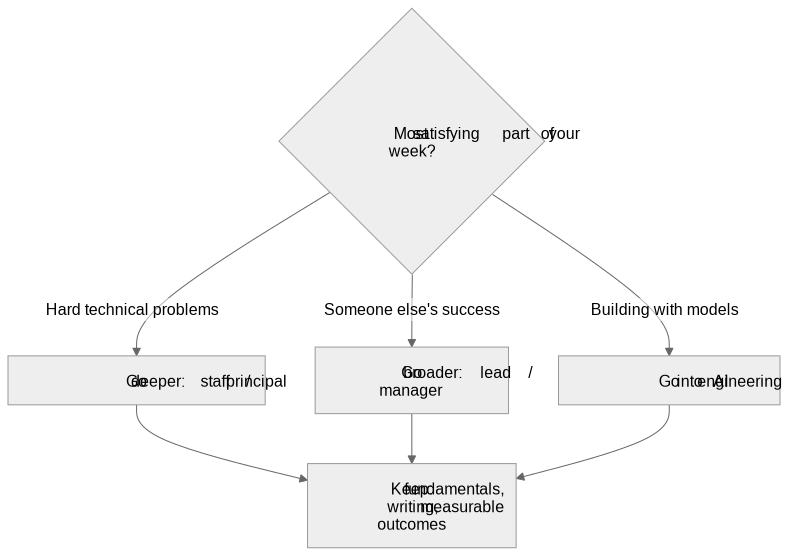
Diagram source
flowchart TD
  Q1{"Most satisfying part of your week?"}
  Q1 -->|"Hard technical problems"| D["Go deeper: staff / principal"]
  Q1 -->|"Someone else's success"| B["Go broader: lead / manager"]
  Q1 -->|"Building with models"| A["Go into AI engineering"]
  D --> K["Keep: fundamentals, writing, measurable outcomes"]
  B --> K
  A --> K
Use case 1: a senior backend engineer who loves the technical work #
Path: go deeper. If this is you, there’s a lot to look forward to. The false lead is thinking a staff or principal engineer was ever valued for typing speed. The real value is:
- seeing the system: how a change in one service affects data, latency, cost and failure modes elsewhere;
- making irreversible decisions well: data models, service boundaries, consistency, vendor choices;
- raising everyone’s bar: design reviews, written standards, examples that others copy;
- leading in incidents and audits: calm, evidence-driven, accountable.
To follow this lead:
- own a cross-team problem end to end, for example latency, cost, reliability or a migration;
- write more: design documents, decision records, and posts like this series, which force clear thinking;
- stay hands-on enough to stay credible. Use AI to build prototypes and measurements faster, then make the decision with evidence.
Use case 2: a tech lead wondering about management #
Path: go broader, if you want the work itself. A common misreading of the clues is that management is a promotion from engineering. It isn’t; it’s a different job, and a rewarding one in its own right: hiring, coaching, prioritising, communicating up and across, and being responsible for a team’s output and wellbeing.
Clues that it might fit:
- you get satisfaction from someone else’s success;
- you’re already doing the planning and unblocking;
- you want to influence how work happens, not only what’s built.
AI makes some of the role new:
- setting standards for AI use: review expectations, testing, security, what can and can’t be generated;
- re-shaping work: where AI speeds teams up, where it creates review load, how to measure real throughput;
- growing junior engineers when the easy tasks they used to learn on are automated: pair them on review, debugging and design instead (the starting-out case is written for them).
Many leaders stay partly hands-on. At CapGrid I lead a 20-engineer organisation and own the platform’s architecture and infrastructure while remaining roughly half hands-on. That mix keeps technical decisions grounded and keeps credibility with the team.
Use case 3: moving into AI #
Path: build AI products, where experienced engineers are scarce. This is the twist I find exciting: models are easy to call and hard to make reliable, so everything you already know about building dependable systems is in demand again. The gaps in most AI teams are exactly what experience provides:
- evaluation: measuring whether the feature works, on held-out data, before and after every change;
- reliability: retries, timeouts, fallbacks, idempotency, observability;
- data and retrieval: schemas, indexing, freshness, permissions;
- security: prompt injection, data leakage, access control;
- cost: caching, routing, model size.
The roles post maps the titles; the evals post shows the core skill. A good way in is to build one AI feature in your current domain and measure it honestly. My own example is an order-ingestion platform that cut quotation turnaround from 45 days to 5.
The reveal: what to keep doing, whichever path #
Line the three paths up and the same habits keep turning up at every scene. That’s the solution, and what I admire about it is how little it asks: no reinvention, just doing the durable parts on purpose.
- Keep your fundamentals sharp. They’re what let you verify AI output and lead technical decisions.
- Write. Design docs, decision records, post-incident reviews, posts. Writing is how experience becomes useful to others, and it’s visible evidence of your judgement.
- Show measurable outcomes: latency, cost, reliability, delivery time, quality. “I cut the cloud bill by 86%” (how) is more convincing than “I know AWS”.
- Use AI tools daily, and develop a sharp sense of where they’re reliable and where they aren’t.
- Build a public body of work: repositories, talks, posts. It compounds, and it speaks for you when you’re not in the room.
Remember this
- Your value is the decisions that are hard to undo, made well.
- Choose the path by the day-to-day work you enjoy, not the title.
- AI is leverage for judgement, and you can tell when its output is wrong.
What I’d tell myself at year five #
- Pick the problems that matter to the business, and measure your results in its terms.
- Learn to write and present decisions; it multiplies everything else.
- Choose the path by the day-to-day work you enjoy, not by the title.
- Treat AI as leverage for your judgement, not a replacement for it.
- Keep something you’ve built where people can see it.
The craft is changing, but the heart of it, understanding systems well enough to make good calls about them, is still here and still a joy. AI gives that understanding more reach.
Comments
No comments yet.
Sign in to comment. We'll email you a link; no password needed.