RBAC, ABAC or ReBAC: how should you model permissions?
Roles answer "what can an editor do?", attributes answer "under which conditions?", relationships answer "who can see this particular document?". Most SaaS products need roles per tenant plus a few attribute rules; sharing features need relationships. Where to enforce them, and why the database…
The verdict, which the scenes below earn: start with roles per tenant, add attribute rules where conditions matter, and use relationships when users share individual items with each other.
- RBAC (role-based): users get roles (
owner,editor,viewer); roles grant permissions. Simple to explain and audit. - ABAC (attribute-based): rules over attributes of the user, the resource and the context (“managers can approve expenses under ₹50,000 in their own department, during business hours”).
- ReBAC (relationship-based): permissions follow a graph (“Asha can edit this doc because she’s in the team that owns the folder that contains it”). This is Google’s Zanzibar model, used by tools like OpenFGA and SpiceDB.
- Enforce in one place in the code, and again in the database for tenant isolation, so a forgotten check can’t leak another customer’s data.
Case file
The case Someone opened a document they shouldn’t have, or couldn’t open one they should Suspects RBAC, ABAC, ReBAC Culprit A permission model that doesn’t fit the product, enforced in scattered checks The fix Tenant-scoped roles, attribute rules for conditions, relationships for sharing, RLS underneath
The case #
Someone opened a document they shouldn’t have. Or someone who should have could not. Either way, the question on the table is the detective’s favourite: “why was this allowed?” Permissions look like a dull corner of an app until you notice that each model is a different way of answering it. Roles, conditions and relationships are three different explanations, and each fits a different kind of product.
The three suspects #
Here they are side by side:
| RBAC | ABAC | ReBAC | |
|---|---|---|---|
| Question it answers | What can this role do? | Is this allowed under these conditions? | Is this user connected to this object? |
| Example | Editors can publish posts | Approvers can approve invoices below their limit, in their region | Viewers of a folder can view every doc in it |
| Data needed | User → roles | Attributes of user, resource, environment | A graph of relationships |
| Strengths | Easy to understand, audit and build UIs for | Expressive; fewer roles | Natural for sharing and nested structures |
| Weaknesses | Role explosion (“editor-EU-readonly-finance”) | Harder to audit (“who can see X?” is hard to answer) | Needs a relationship store; consistency is subtle |
| Tools | Any framework; a role column |
OPA/Rego, Cedar, policy code | OpenFGA, SpiceDB, Permify, Ory Keto |
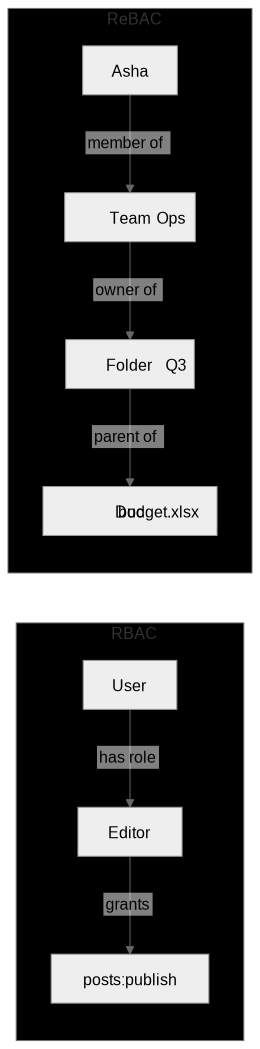
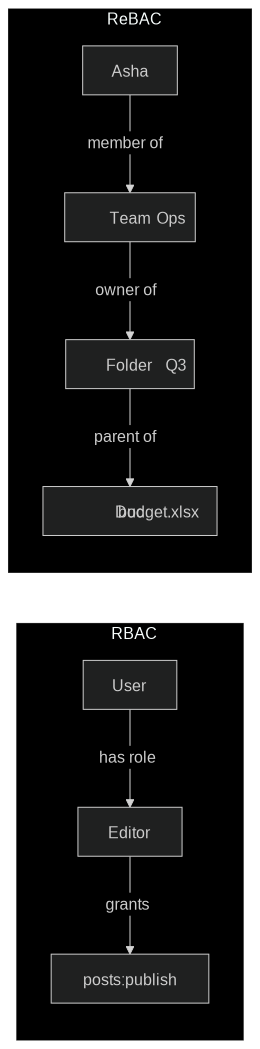
Diagram source
flowchart LR
  subgraph RBAC
    U1[User] -->|has role| R1[Editor] -->|grants| P1[posts:publish]
  end
  subgraph ReBAC
    U2[Asha] -->|member of| T[Team Ops] -->|owner of| F[Folder Q3] -->|parent of| D[Doc budget.xlsx]
  end
Use case 1: multi-tenant SaaS #
The scene: each customer (tenant) has users with different rights inside their own workspace.
What I’d use: RBAC scoped by tenant, plus tenant isolation in the database. Its charm is its plainness: anyone can read the role table and see who can do what.
- A membership table:
(tenant_id, user_id, role). A user can be an admin in one tenant and a viewer in another. - Permissions per role in code:
{"admin": [...], "editor": ["posts:write", "posts:publish"], "viewer": ["posts:read"]}. - Every query is scoped to the tenant, enforced by PostgreSQL row-level security as well as application code, so a bug in a handler returns nothing rather than another customer’s data. The tenant isolation case shows the policies.
Use case 2: document sharing #
The scene: users share folders and documents with people and groups, and permissions inherit down the folder tree.
What I’d use: ReBAC. This is where Zanzibar’s insight shines, and it’s a beautiful one: if permissions are edges in a graph, sharing and inheritance stop being special cases.
- Store relationships as tuples:
doc:budget#parent@folder:q3,folder:q3#owner@team:ops#member,team:ops#member@user:asha. - A check walks the graph: can
user:ashaeditdoc:budget? - Listing (“which docs can Asha see?”) needs the system’s list API or a precomputed index; it’s the hard part, and the reason to use a dedicated service rather than recursive SQL. Recursive SQL is the tempting false lead here.
Use case 3: regulated data and approval limits #
The scene: finance approvals with amount limits, region restrictions and separation of duties (you can’t approve your own expense).
What I’d use: RBAC for the coarse structure plus ABAC policies for the conditions.
- Roles decide who may approve at all; attributes handle the nuance.
- Policies check attributes:
amount <= user.limit,invoice.region in user.regions,invoice.submitted_by != user.id. - Keep policies as code (OPA/Rego, Cedar, or plain functions), versioned and tested with tables of allow/deny cases, and log every decision for auditors.
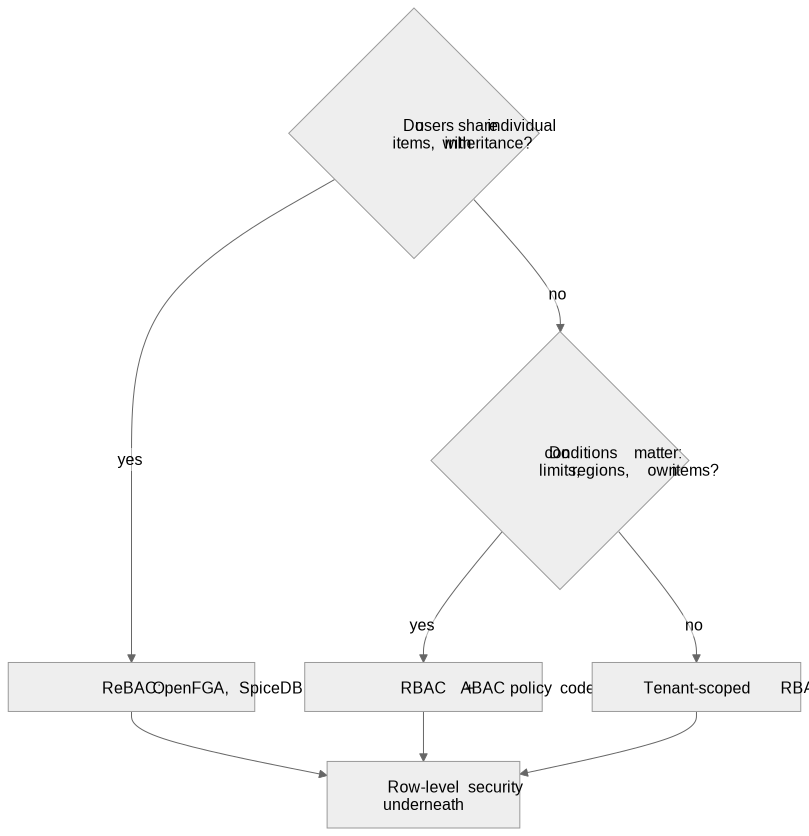
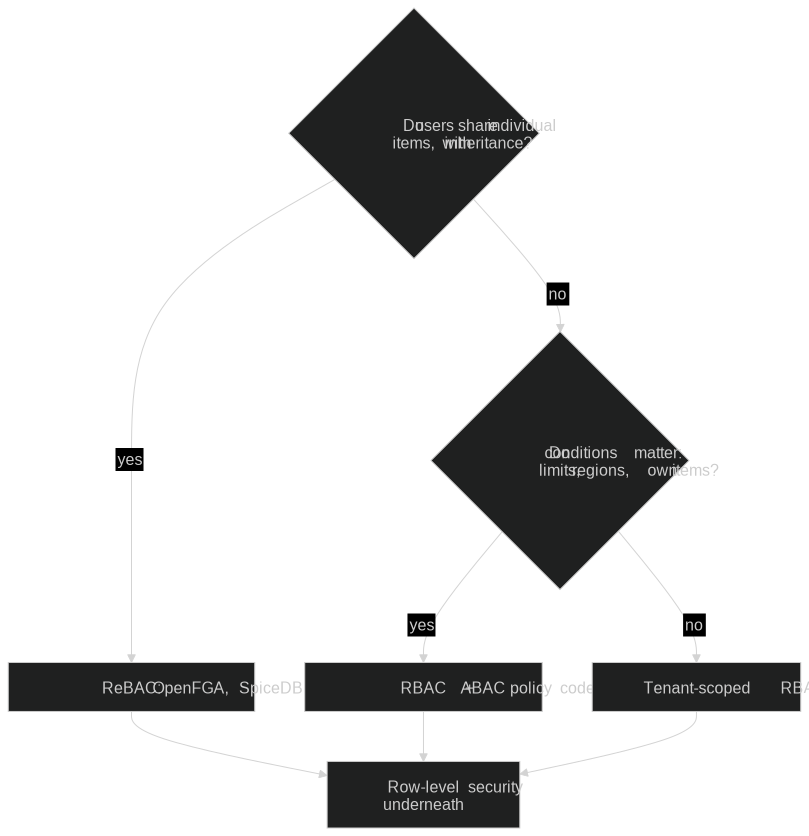
Diagram source
flowchart TD
  Q1{"Do users share individual items, with inheritance?"}
  Q1 -->|yes| RE["ReBAC: OpenFGA, SpiceDB"]
  Q1 -->|no| Q2{"Do conditions matter: limits, regions, own items?"}
  Q2 -->|yes| AB["RBAC + ABAC policy code"]
  Q2 -->|no| RB["Tenant-scoped RBAC"]
  RE --> DB["Row-level security underneath"]
  AB --> DB
  RB --> DB
Where the guards stand #
- At the edge: authentication (the OAuth and OIDC case covers the flows), coarse checks (is this a staff-only route?).
- In the application, in one place: a single
authorize(user, action, resource)function or middleware, never ad-hocif user.role == ...scattered through handlers. - In the database for tenant isolation (RLS) and anything where a leak would be catastrophic.
- In the UI only for hiding buttons; the UI is never the enforcement, and treating it as one is a classic red herring.
Remember this
- Roles answer “what can this role do”, attributes “under what conditions”, relationships “how is this user connected”.
- One
authorize(user, action, resource)function, never scattered role checks.- The UI hides buttons, the database holds the line.
What I’d do on Monday #
- Tenant-scoped RBAC with a small, fixed set of roles.
- Attribute rules as tested policy code for conditions and limits.
- ReBAC (OpenFGA or SpiceDB) when sharing and inheritance arrive.
- One authorisation function, plus row-level security as the safety net.
- Log decisions and review roles regularly; remove access when people change jobs.
In the end, nobody is the culprit: these models layer rather than compete. Start with roles, let conditions and relationships join when the product asks for them, and keep the database holding the line underneath.
Comments
No comments yet.
Sign in to comment. We'll email you a link; no password needed.