Test-first or test-after: what actually reduces bugs?
Writing the test first helps most when the expected behaviour is clear and the design isn't: parsers, rules, bug fixes. Property-based tests find edge cases nobody thought of. Integration tests against real dependencies catch what unit tests can't. How to combine them.
Short answer: the verdict, as the cases below will show: the order matters less than what you test and against what.
- Test-first (TDD) works best for pure logic with clear expected behaviour, and for every bug fix: write the failing test that reproduces the bug, then fix it.
- Test-after is fine when you’re exploring a design, as long as the tests are written before the code is merged, not “later”.
- Property-based tests find edge cases you didn’t think of.
- Integration tests against real dependencies (a real database, a real queue in Docker) catch the bugs that matter most in services: queries, permissions, transactions, concurrency.
The case is familiar: a suite that’s green, a release that ships, and a bug in production anyway. Was it because the tests were written after the code instead of before? That’s the usual suspect, and it’s mostly a red herring. People argue about this with real passion, because every approach here contains a good idea. Kent Beck’s insight with TDD was that a test can shape a design as well as check it; QuickCheck’s authors, Koen Claessen and John Hughes, showed that a computer can invent better edge cases than we can. The fun is in using each where it shines.
Case file
The case A green suite, a release, and a bug in production anyway Suspects Tests written after the code instead of before Culprit Testing the wrong thing, or against mocks instead of real dependencies The fix Match the test to the bug: TDD for logic, properties for edge cases, integration tests against the real database Evidence The blogging platform’s store tests against a real PostgreSQL, and the database trade-offs lab
The suspects at a glance #
| TDD | Test-after | Property-based | Integration-heavy | |
|---|---|---|---|---|
| You write | A failing test, then the code | Code, then tests | Rules that must always hold; the tool generates inputs | Tests that run the real stack (database, queue) |
| Best for | Parsers, rules, calculations, bug fixes | Exploratory code, UI, prototypes | Parsers, encoders, data structures, anything with invariants | Services, data access, security rules, concurrency |
| Catches | Logic errors; also shapes the API | Regressions | Edge cases (empty, huge, unicode, boundaries) | Wrong SQL, missing permissions, race conditions, config |
| Cost | Discipline; slower start | Risk of skipping or writing weak tests | Learning to state properties | Slower tests; need Docker in CI |
The “Catches” row is the clue. Each approach catches a different kind of bug, so the question was never which one wins. It’s which kind of bug you’re hunting.
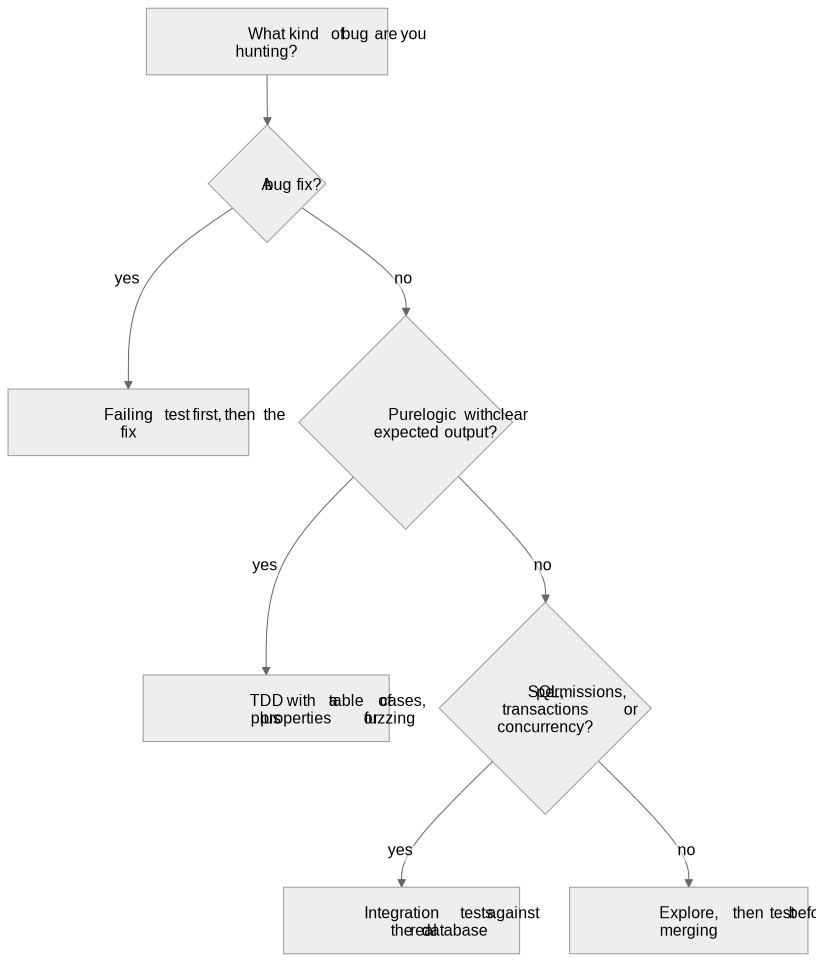
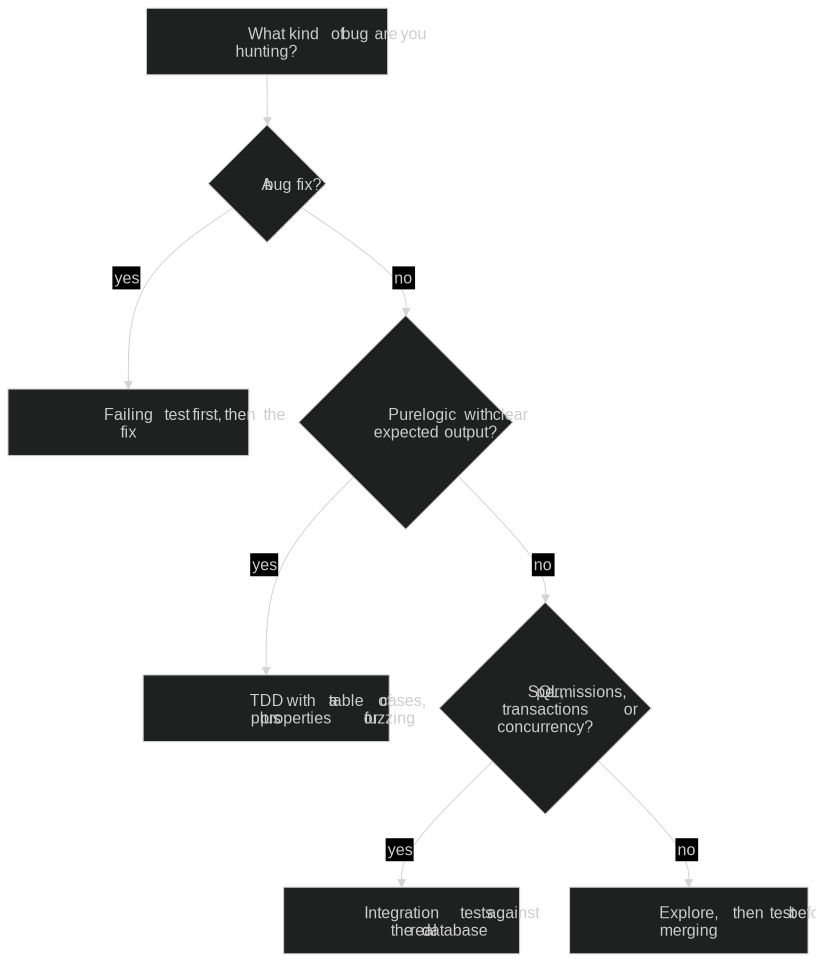
Diagram source
flowchart TD
  A["What kind of bug are you hunting?"] --> B{"A bug fix?"}
  B -- yes --> T1["Failing test first, then the fix"]
  B -- no --> C{"Pure logic with clear expected output?"}
  C -- yes --> T2["TDD with a table of cases, plus properties or fuzzing"]
  C -- no --> D{"SQL, permissions, transactions or concurrency?"}
  D -- yes --> T3["Integration tests against the real database"]
  D -- no --> T4["Explore, then test before merging"]
Case 1: a parser #
The situation: you need to normalise messy part numbers (AB-123/x, ab123x, AB 123 X) to one form.
What I’d do: TDD with a table of cases, then a property test.
- Write the table first: input, expected output. Each new oddity from real documents becomes a row.
- Add properties, which is where it gets interesting: normalising twice gives the same result as once (idempotence); the output contains only allowed characters; no input crashes it. You stop listing suspects one by one and describe what every innocent answer must look like.
Go’s built-in fuzzing (go test -fuzz) is a cheap way to get the “no input crashes it” property. The part-number matching post has the real cases.
Case 2: a security rule in the database #
The situation: each blog’s posts must be invisible to every other tenant, enforced by PostgreSQL row-level security.
What I’d do: integration tests against a real PostgreSQL, written alongside the policy.
- Create two tenants. As tenant A, try to read, update and delete tenant B’s rows. Every attempt must fail or return nothing.
- Try with no tenant set: nothing must match.
- Run as the same database role the app uses in production, not a superuser (superusers, and table owners unless RLS is forced, bypass it, so such a test proves nothing).
The blogging platform I run has store tests like these. Here’s the false lead: a mock of the database would pass all of them and prove nothing. There’s something reassuring about watching a real database refuse tenant A’s request for tenant B’s rows. The RLS post explains the policies.
Case 3: a concurrency bug #
The situation: two requests occasionally sell the last item twice. The bug only shows up sometimes, which is what makes it a proper mystery.
What I’d do: reproduce it with a test before fixing it.
- Write a test that starts many concurrent requests against a real database and checks the invariant (stock never below zero, exactly one winner).
- Watch it fail. That failing test is the confession. Fix it (a conditional update, a lock, or optimistic concurrency).
- Keep the test; run it with Go’s race detector where relevant.
The lock or retry post and the database trade-offs lab have tests in this style: each one pins a behaviour (who wins, what’s blocked, what’s lost) so a change in database settings or code shows up as a failing test.
What makes a test worth keeping #
Whichever order you write them in, good tests share a few qualities.
- It tests behaviour, not implementation. It calls the public function or endpoint and checks the result, so refactoring doesn’t break it.
- It fails for one clear reason and the message says what went wrong.
- It’s deterministic. No sleeps hoping something finished; no dependence on test order or wall-clock time.
- It’s fast enough to run on every change. Integration tests can be fast too: the blogging platform’s whole suite, against a real database, takes seconds.
Another false lead: coverage numbers #
Coverage tells you what wasn’t run, not what was tested well. Aim for the risky paths (authorisation, money, data deletion, concurrency) to be covered by tests that would fail if the behaviour changed, and don’t chase a percentage.
Remember this
- The order matters less than what you test and against what.
- Every bug fix starts with a failing test.
- A mocked database proves nothing about SQL, permissions or concurrency.
Case closed: what I’d do by default #
- Every bug fix starts with a failing test.
- TDD for parsers, rules and calculations; tables of cases, plus properties or fuzzing.
- Integration tests against the real database and queue for anything involving SQL, permissions, transactions or concurrency.
- A few end-to-end tests for the main user journeys, not hundreds.
- Tests run in CI on every change, and a flaky test is fixed or deleted, never ignored.
The real reward isn’t a coverage badge. It’s the freedom a good test suite gives you: to refactor boldly, fix bugs once, and trust that the thing you built still does what you meant it to.
Comments
No comments yet.
Sign in to comment. We'll email you a link; no password needed.