Do I need Kubernetes?
Probably not yet. Plain EC2 with Docker, or ECS on Fargate, runs most small and mid-sized products with far less to operate. When Kubernetes (EKS) earns its complexity, and what each option costs you in money, people and on-call.
The verdict, which we’ll test against the evidence: probably not yet.
- A few services and a small team: EC2 with Docker (or a process manager), or ECS on Fargate, gives you containers, rolling deploys, auto scaling and health checks with a fraction of the operational load.
- Kubernetes (EKS on AWS) earns its complexity when you have many services and teams, need its ecosystem (operators, service meshes, GitOps tooling), want to run the same way across clouds or on-premises, or already have people who run it well.
The cost of Kubernetes isn’t the control-plane fee; it’s the expertise and attention it needs, every week.
The case usually opens the same way: a small team, a handful of services, and a nagging feeling that “real” companies run Kubernetes, so maybe the slow deploys and the late-night restarts are a sign you should too. Kubernetes is a remarkable piece of engineering: a whole vocabulary for describing how software should run, with a control loop that keeps nudging reality towards it. The question isn’t whether it’s good, but whether you need what it offers right now.
Case file
The case Slow deploys, late-night restarts, a feeling that “real” companies run Kubernetes Suspects EC2 + Docker, ECS on Fargate, EKS Culprit The unwritten cost: expertise and attention every week The fix Start on ECS with Fargate, move to EKS with scale, need and a platform owner
The suspects #
All three give you containers; they differ in how much of the machinery you hold. Line them up and the differences are in the details.
| EC2 + Docker / PM2 | ECS (Fargate or EC2) | EKS (Kubernetes) | |
|---|---|---|---|
| What you manage | Instances, OS patching, deploy scripts | Task definitions and services; on Fargate, no servers | The cluster’s add-ons, node groups, upgrades, networking, RBAC, plus your workloads |
| Deploys | Your scripts, or CodeDeploy | Rolling or blue/green, built in | Deployments, plus Helm or GitOps tooling |
| Scaling | Auto Scaling groups | Service auto scaling; capacity providers | Horizontal Pod Autoscaler, node autoscaling (Karpenter or Cluster Autoscaler) |
| Learning curve | Low | Low to medium | High |
| Portability | High (it’s just Linux) | AWS only | High: standard APIs on any cloud or on-premises |
| Ecosystem | Linux tools | AWS integrations | Huge: operators, meshes, policy engines, GitOps |
| Extra fixed cost | None | None | A per-cluster control-plane fee, plus add-on nodes |
| Pick it when | 1-3 services, one team, steady load | A growing number of services on AWS, small platform team | Many services and teams, Kubernetes skills in-house, need for its ecosystem or portability |
Case 1: one to three services, a small team #
What I’d use: ECS on Fargate, or EC2 with Docker.
- ECS on Fargate: you describe a task (image, CPU, memory, environment, secrets), and a service keeps N copies running behind a load balancer, replacing unhealthy ones and rolling out new versions. There are no servers to patch: a small amount of thinking for a lot of capability, which is the quiet elegance of it.
- EC2 with Docker Compose or PM2 is simpler still, and fine for steady workloads. My node22-pnpm-pm2-chromium image (Node.js, PM2 and headless Chromium for PDF and scraping work) is built for exactly this kind of deployment, and has been pulled over 2,000 times.
Either way: build images in CI, push to ECR, and deploy with one command. Defining the stack in Terraform or CloudFormation makes it reproducible; my multi-tenant reference includes Terraform for ECS on Fargate with SQS and alarms.
Case 2: 10+ services and a platform team #
What I’d consider: EKS, if the organisation is ready for it.
This is where the evidence finally points towards Kubernetes, and where it comes into its own. It shines when:
- many teams deploy many services and benefit from one consistent platform (namespaces, quotas, standard deployment manifests);
- you need the ecosystem: operators for databases and queues, service meshes for mTLS and traffic shifting, policy engines, GitOps;
- portability matters: the same manifests run on AWS, another cloud, or on-premises;
- someone owns the platform: cluster upgrades several times a year, add-on compatibility, networking and IP planning, node lifecycle, security patching, RBAC, and on-call for the cluster itself.
That last condition is the clue people overlook. Without a platform owner, Kubernetes becomes the thing every product team is half-responsible for and nobody fully understands. ECS still scales to many services; it’s a reasonable choice at this size too.
Case 3: bursty batch jobs #
Situation: nightly reports, document processing in bursts, data backfills.
What I’d use: Fargate tasks started on a schedule (EventBridge Scheduler) or from a queue, Lambda if each unit of work fits its limits (up to 15 minutes and 10 GB of memory, as of Nov 2026; Lambda Managed Instances allow 90-minute runs on EC2 capacity, and durable functions can pause long workflows between steps), or AWS Batch for large job queues. Pay while the work runs, and nothing when idle. On Kubernetes the equivalent is Jobs on autoscaled nodes, which is fine if you already run a cluster, and a lot to set up for this alone; reaching for a cluster here is a false lead. The Lambda, Fargate or EC2 post works through the cost side.
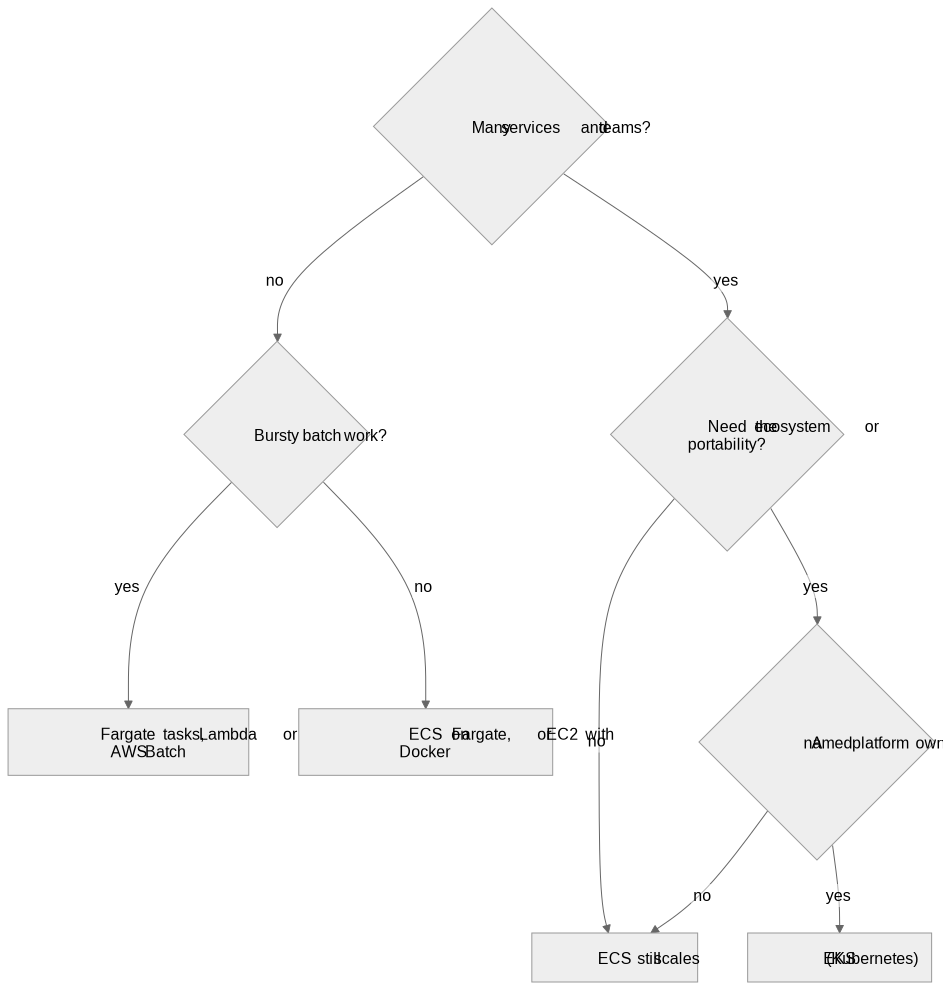
Diagram source
flowchart TD
  Q1{"Many services and teams?"} -- no --> Q2{"Bursty batch work?"}
  Q2 -- yes --> B["Fargate tasks, Lambda or AWS Batch"]
  Q2 -- no --> E["ECS on Fargate, or EC2 with Docker"]
  Q1 -- yes --> Q3{"Need the ecosystem or portability?"}
  Q3 -- no --> E2["ECS still scales"]
  Q3 -- yes --> Q4{"A named platform owner?"}
  Q4 -- no --> E2
  Q4 -- yes --> K["EKS (Kubernetes)"]
Following the money #
The bill has a line for compute and an unwritten line for attention; both are worth counting, and the second one is where the real culprit hides.
- ECS on Fargate: you pay per vCPU and GB of memory per second while tasks run, more per unit than an equivalent EC2 instance, in exchange for no servers. ECS on EC2 is cheaper at steady load, and you manage the instances.
- EKS: a fixed hourly fee per cluster for the control plane, plus the nodes (EC2 or Fargate), plus the cluster add-ons’ own resources, plus, above all, people’s time. Count the hours of platform work per month honestly.
- Savings Plans apply across EC2, Fargate and Lambda, so commit to a baseline of compute whichever you choose.
Remember this
- The cost of Kubernetes is people’s attention, not the control-plane fee.
- ECS on Fargate gives containers, rolling deploys and scaling with no servers.
- Containerise and go stateless now: it transfers to Kubernetes later.
Case closed: what I’d do by default #
- Start on ECS with Fargate (or EC2 with Docker for a single steady service), with infrastructure as code and CI-built images.
- Move to EKS when you have the scale, the need and the people: many services and teams, a use for the ecosystem or for portability, and a named platform owner.
- Don’t adopt Kubernetes for a résumé or a future that isn’t here. You can migrate containers to it later; the hard part, containerising and making services stateless, transfers directly.
That last point is the encouraging one, and the part of the solution I admire most: the good habits are the same whichever platform you pick. Get them right on something simple, and Kubernetes will still be there on the day you need it.
Comments
No comments yet.
Sign in to comment. We'll email you a link; no password needed.